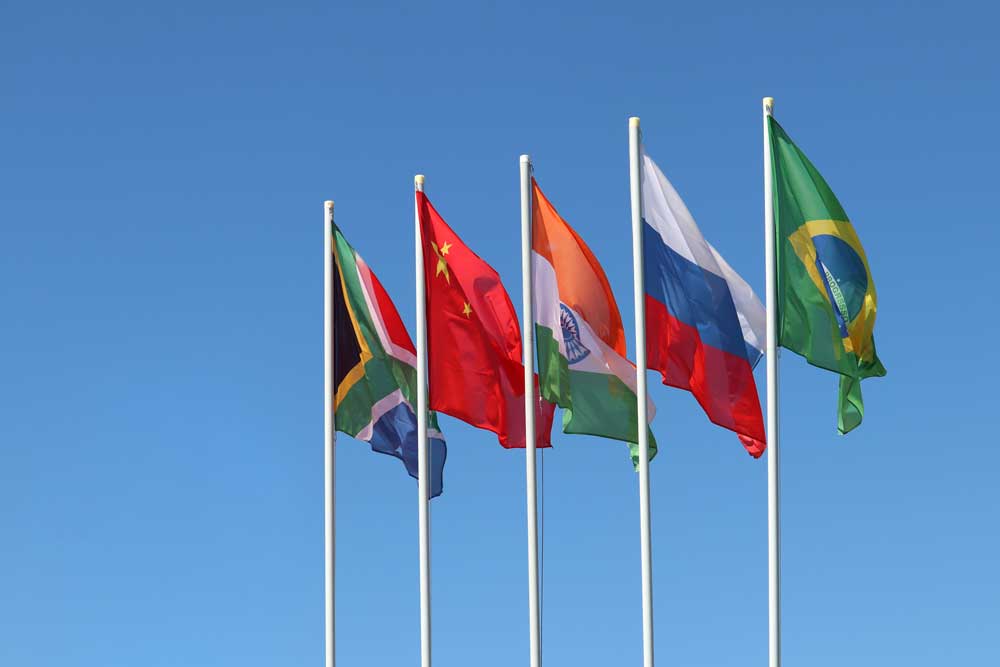
By almost any measure, the countries gathering in Kochi on July 8 and 9 could hardly be more different. Brazil is a vibrant country, China is governed by a single-party system. Saudi Arabia is an absolute monarchy undergoing rapid economic transformation, India is the world's largest democracy, Russia continues to operate under Western sanctions, and South Africa wrestles with inequality. Newer BRICS members such as Egypt, Ethiopia, Iran, Indonesia and the United Arab Emirates bring their own distinct political and economic realities.
The 11 BRICS nations represent nearly half the world's population and about 40 per cent of global GDP by purchasing power. Despite their differences on trade, geopolitics, security and global governance, they are beginning to find common ground in a simple truth: women-led development is not just a social imperative but an economic one.
Increasingly, they are being recognised as central to economic growth and innovation. That makes the BRICS Women's Ministerial Meeting in Kochi, Kerala far more than another diplomatic event. It shows that there is a larger shift in how some of the world's biggest emerging economies are thinking about development itself.
Beyond Empowerment
International conversations about women have mainly focused on empowerment, reiterating that women deserve equal opportunities, equal rights and equal representation. But the global conversation is finally changing. Today, finance ministers, central banks, multilateral institutions and business leaders increasingly speak about women in terms of labour-force participation, productivity, entrepreneurship, digital inclusion, financial access and innovation.
The International Monetary Fund (IMF) has repeatedly estimated that closing gender gaps in employment could substantially increase GDP in many countries. The World Bank continues to identify women's economic participation as one of the strongest drivers of poverty reduction and sustainable growth. The Organisation for Economic Co-operation and Development (OECD) has similarly argued that economies with greater gender inclusion tend to be more resilient and productive. In other words, gender equality is moving from social policy into finance.
India's Idea: Women-led Development
India has helped shape this new narrative by popularising the phrase ‘women-led development.’ The earlier notion of ‘women-centric development’ treats women as beneficiaries of government programmes. Women-led development on the other hand, sees women as creators of growth, innovators, employers, farmers, investors, scientists and decision-makers. The most fascinating aspect of BRICS is that every country has reached this conclusion differently.

India has witnessed an explosion of women using digital public infrastructure such as Aadhaar and Jan Dhan accounts, Unified Payments Interface (UPI) in order to access banking, government benefits and run small businesses.
In Saudi Arabia, under Vision 2030, female labour-force participation has risen dramatically, surpassing many of the government's original targets years ahead of schedule. Women are entering professions that were once largely closed to them, from finance and law to aviation, engineering and technology. The reforms are central to the Kingdom's strategy of reducing dependence on oil and building a diversified economy.
China’s booming digital economy has produced millions of women entrepreneurs who sell everything from cosmetics to agricultural products through e-commerce platforms and live-streaming. Women have become significant contributors to China's consumer economy and digital innovation ecosystem.
Brazil, meanwhile, has seen women emerge as major players in agribusiness, food production and community-led enterprises. Across Latin America's largest economy, women-owned small businesses have become increasingly important contributors to employment and local economic resilience.
The United Arab Emirates has invested heavily in increasing women's participation across government, business, technology and space research. Women now occupy prominent positions in public administration and corporate leadership as the country positions itself as a global innovation hub.
Even South Africa, despite persistent structural inequalities, has prioritised women entrepreneurs and financial inclusion as part of broader efforts to address unemployment and inclusive growth. Each country may have chosen its own pathway, but all roads appear to lead to the same destination.
The BRICS Agenda

The discussions at the BRICS Kochi meet are expected to focus on four interconnected themes:
*Women’s leadership and governance
* Women’s entrepreneurship, financial inclusion and digital access
* Skill development
* Women’s role in climate resilience, food security and nutrition
One of the strongest themes likely to emerge from Kochi is ‘digital inclusion'. Women who were historically excluded from formal finance and business networks, now have new routes into entrepreneurship and employment. Technology is lowering some of the barriers that kept millions of women outside formal economic systems.
Another key topic in Kochi is climate resilience. Across many BRICS countries, women are responsible for farming, water collection, food preparation and household nutrition. When droughts, floods or extreme weather strike, they are often among the first to experience the consequences.
Yet, women manage to innovate. From climate-smart agriculture in India and Ethiopia to community-farming initiatives in Brazil and water conservation projects across Africa, women are developing local solutions that improve both livelihoods and environmental sustainability. Recognising women as climate leaders as opposed to beneficiaries of relief programmes marks another important shift in development thinking.
The Question That Matters

The real challenge begins after the delegates fly home. Can BRICS move beyond speeches and establish practical mechanisms for cooperation? For the discussions to succeed, women entrepreneurs need to find easier access to markets across BRICS economies. Ministers must help establish permanent research partnerships, innovation exchanges, leadership fellowships and climate collaborations instead of one-off conferences. These are the kinds of institutional arrangements that could transform lofty commitments into measurable outcomes.
Countries with profound ideological differences are increasingly arriving at the same economic truth. No nation can achieve its growth ambitions while leaving half of its talent behind. That may well be one of the defining geopolitical stories of our time.
If BRICS can translate this conviction into measurable policy, sustained investment, strong institutional partnerships and meaningful cross-country collaboration, it could shape a new model of women-led development, not just for its members, but also for emerging economies across the Global South.