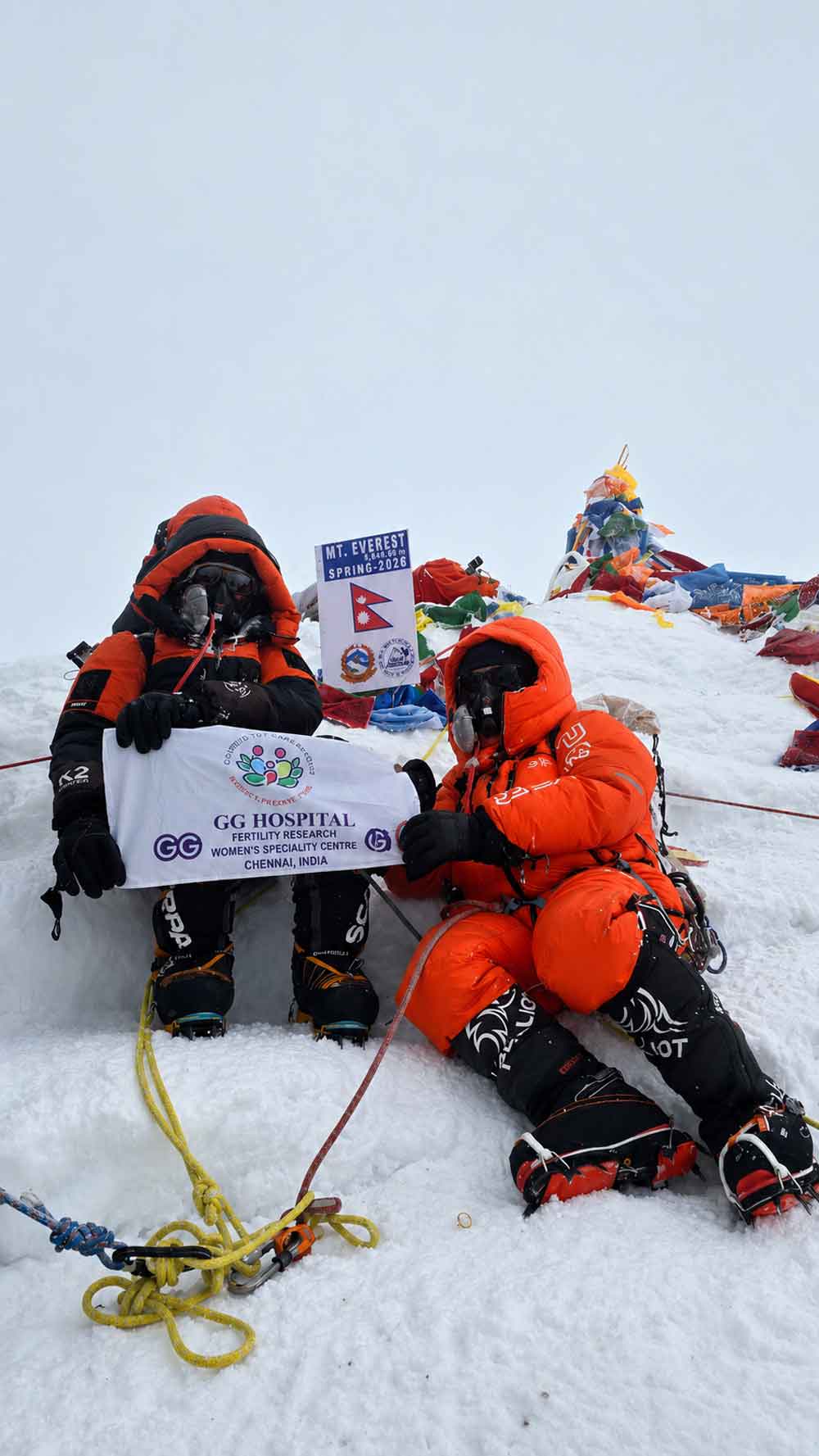
Standing on the summit of Mount Everest, nearly 8,850 metres above sea level, Dr Priya Selvaraj wasn't thinking about records or accolades. Instead, she felt a sense of gratitude, almost like prayer. For one of India's leading fertility specialists, reaching the highest point on Earth wasn't the culmination of a lifelong mountaineering dream, but a deeply personal journey that began in the aftermath of the Covid-19 pandemic.
Discovering The Mountains
‘I suffered a profound personal loss when my father passed away during the first wave of Covid-19. To make matters worse, 2021 became a year of burnout as I also lost several colleagues and friends, both to the pandemic and its relentless toll,’ says Dr Priya. ‘I knew I had to get away from this environment if there was any possibility of travel, somewhere close to nature. While a friend and I were researching, we came across a mountain retreat that was great for recovery. Since we were both fitness enthusiasts, we thought we could opt for a trek instead. We chose to visit Sandakphu, the highest peak in West Bengal, a trail that wove between India and Nepal.’
‘Once we accomplished that, there was no going back for me. I loved meeting like-minded people, professionals from all walks of life, whether dancers or lawyers, who shared the same mindset. We wanted to put ourselves through some form of physical endurance, embracing nature and minimalism. Of course, the whole journey came with its own challenges from the weather to the toilet conditions, but even through it all, the conversations and company were incredibly fulfilling.’
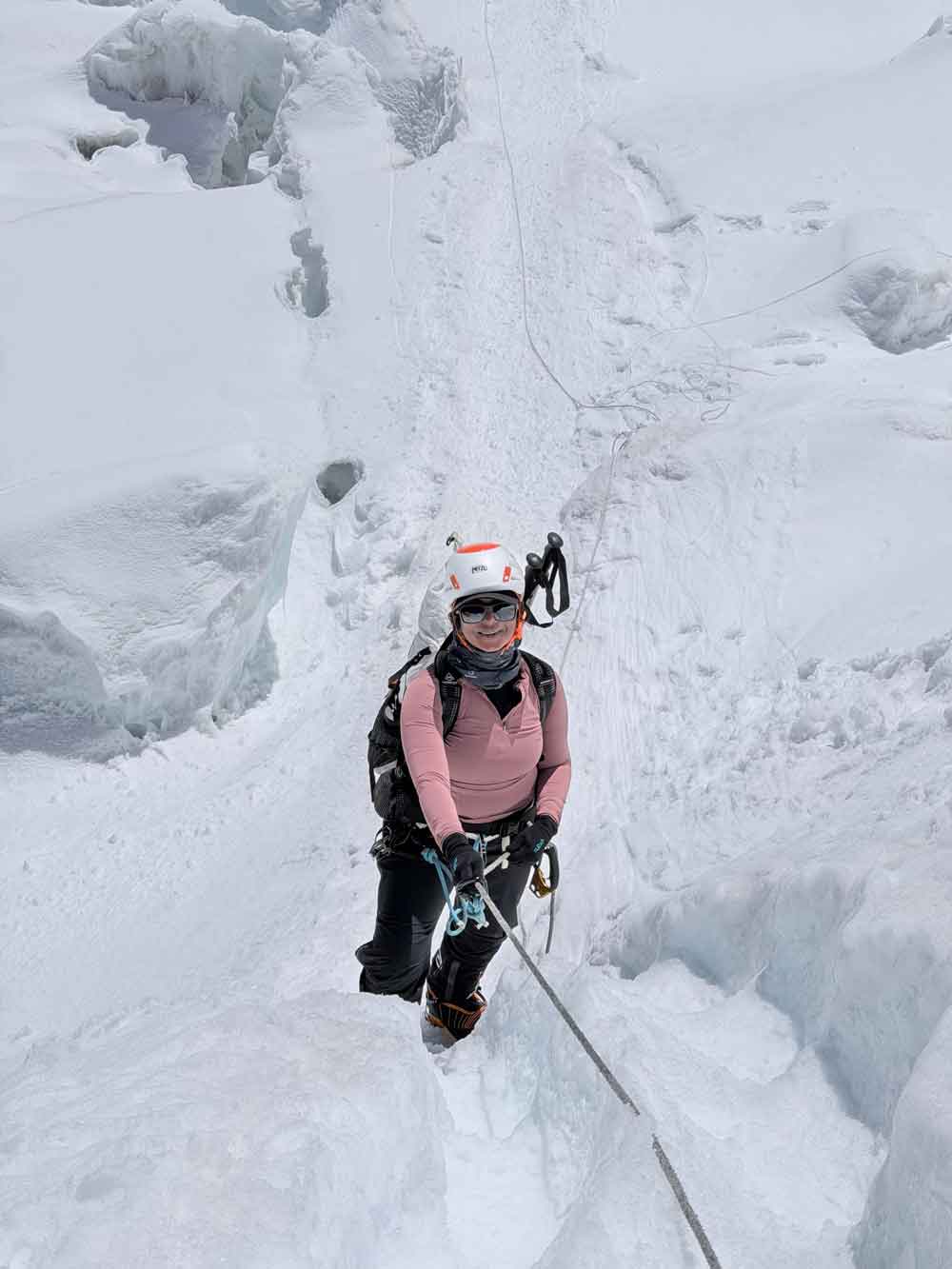
Dr Priya felt that she was able to process her life and feelings with more clarity up in the mountains. One trek led to the next, and it soon became a tradition to head away for a week or 10 days, then gradually for two or three weeks, and eventually for a month or even 45 days. ‘I started off with grief and loss at the back of my mind, but I realised I was able to accept many things and also reset my life in a better way when I returned. Each journey brought a new learning.’
The Physical Journey
Long before Mount Everest entered the picture, fitness had already become an integral part of Dr Priya’s life. A childhood asthmatic, she discovered early that regular exercise dramatically improved her health. After having three children between 2003 and 2006, while balancing an increasingly demanding medical career, she made a promise to herself that fitness would no longer be optional. She hired a trainer and committed to four sessions a week. That consistency gave her an advantage over others.
‘I can’t say I started training late, but training for climbing mountains is a bit different. You have to be into active fitness for a minimum of three to four months before treks, and for at least a year before expeditions. There must be a structured plan in place, as you might face other injuries or something else may come up. You have to be fit enough to heal from those setbacks before you go on your expedition. Then you have to combine strength training with cardiovascular endurance. Since you’re climbing high altitudes with low oxygen, you need cardiovascular endurance to tide over that, even if oxygen is provided. Start cycling, running, swimming, or martial arts; anything where you can get your heart rate high. Hips, knees, and ankles are load-bearing joints, particularly during descents, so you have to work on building joint stability. You can’t just wake up one day and decide you’re going to climb a mountain. It has to be a dedicated effort.’
The Mental Preparation
Dr Priya believes that mountains themselves prepare you in ways that no amount of physical training can. ‘I began trekking in 2021 at the age of 48, bringing with me years of life experience and the training that comes from working in a high-pressure hospital environment. As doctors, we're trained to face challenges and difficult outcomes, but the mountains demand a different kind of endurance.’
‘Life on an expedition is far removed from everyday comforts. You're living in tents, dealing with unpredictable weather, unfamiliar food, and extreme physical exertion. While months of training prepare your body, it's only when you're on the mountain that your mind is truly tested. Fear, fatigue, and self-doubt inevitably surface. Before every climb, I tell myself that I've been trained for this and that I need to trust my expedition leader. But there are moments when the mountain pushes you to your limits. Every climber has moments of vulnerability. We all cry in our tents, even if no one sees it. That's why it's important to surround yourself with people who encourage you rather than discourage you.’
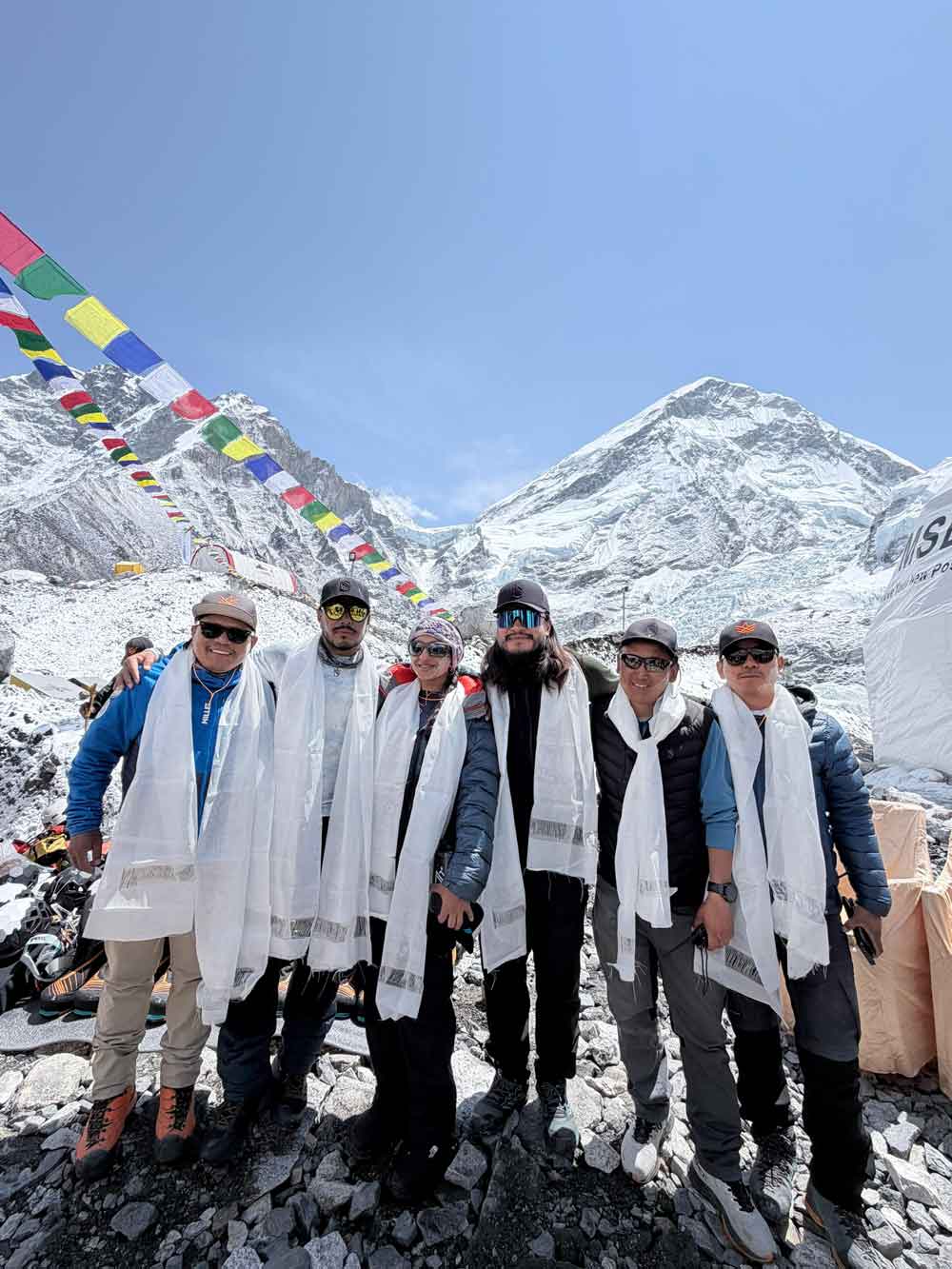
During her climbs, she chose to speak to people who would stay positive. Among her friends, she realised nine out of ten would tell her to return when things got tough, while only one would ask her to hang in there. She says her children and coach were her constant go-to people. ‘My children are young, but they’re also aware because I prepared them mentally, conditioning them for the fact that I was going on an expedition involving a lot of risks. Whenever I called them, they would always say, ‘Ma, you can do this’. They asked me to use my judgement and turn back if there were any challenges that I knew I couldn’t overcome. My coach always reiterated that wisdom comes first, but he also told me that I had been trained for this and could continue at my own pace with determination and grit. He would always remind me to complete my warm-up and cool-down exercises.’
The Mountain Of Spirit
Six-and-a-half months before she embarked on Mount Everest, Dr Priya ascended Manaslu in September 2025. That was her first 8,000-metre climb. ‘For this, you have to have a certificate of completion for any peak around 6,000 to 7,000 metres, which I had obtained in 2024. Manaslu means ‘mountain of spirit’, and I went with the belief that this was a spiritual journey, seeking her blessings to open up my avenues for the future. Although my challenges and responsibilities back home were many, when I started the expedition, I felt calm.’
She adds, ‘The ascent was difficult, descent was even more so, but there was a certain sense of peace and something within me that told me I could do this. My sherpas, expedition leaders, and fellow climbers were very supportive. It was a unique experience, but one that not many people talk about. Only a few people know Manaslu, but my company told me that it was my first step towards preparing for Mount Everest, as it required similar training and had similar terrain.’
The Highest Peak
‘I really thought I was ready for Everest, both mentally and physically, but I realised how tough it was only when I started climbing,’ says Dr Priya. ‘I have newfound respect for those who have accomplished it. I used to think it was very commercial and too crowded, and was also scared of Sagarmatha (the Nepali name for Mount Everest), wondering whether I would be given passage to the tallest peak and return safely. In fact, I kept putting it off, but it was chosen for me by everyone around me.’
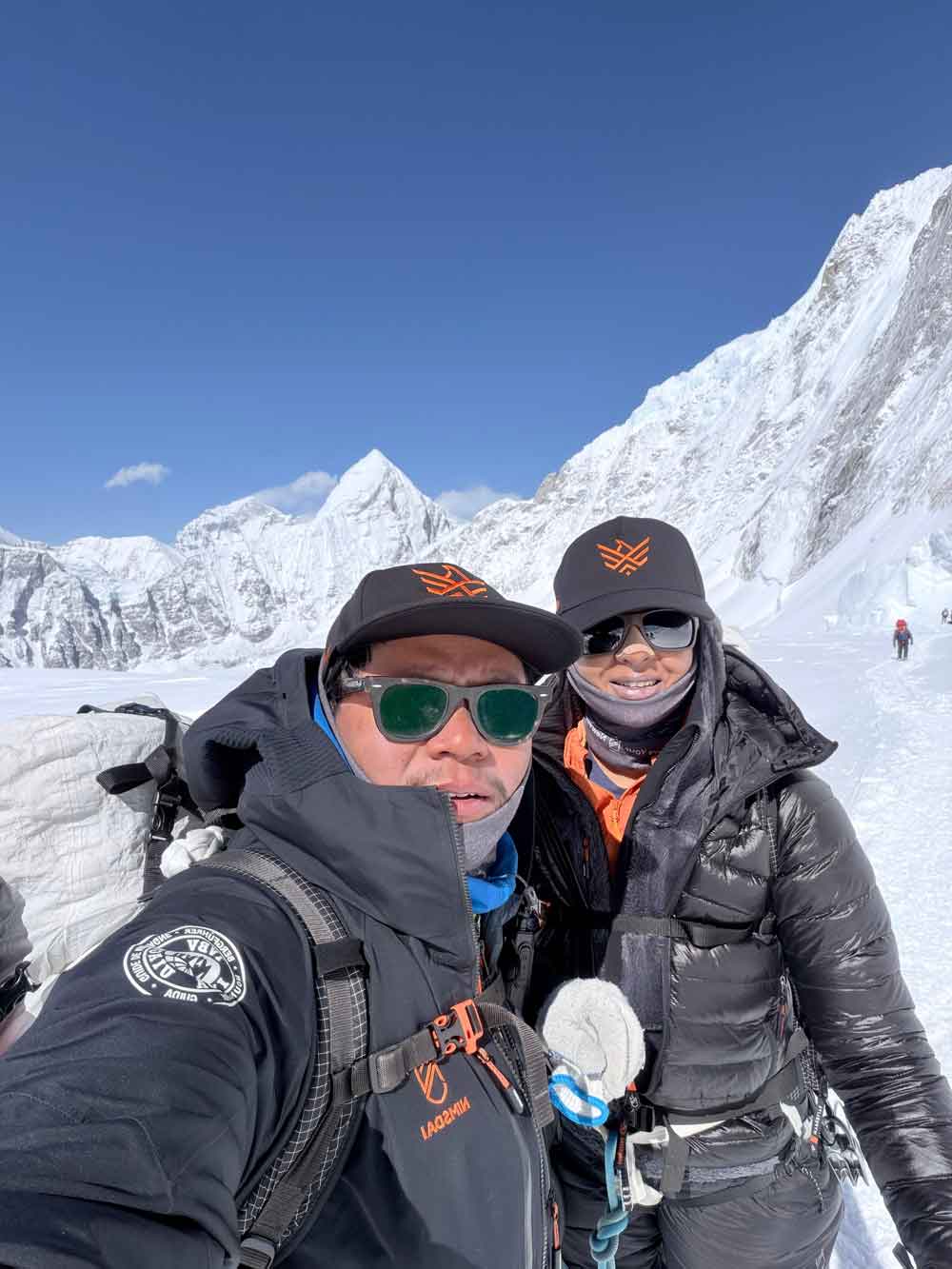
Dr Priya experienced overwhelming emotions only on this mountain, even contemplating turning back. More than fear, she felt self-doubt. There were a record number of climbers this year. In her batch, 24 people were divided into two groups, and she was part of the second group of 10. ‘The first group got caught in the crowds because of the weather window. This is the first time during the Everest season that we were delayed by three weeks because there was a huge serac, and the ice doctors were waiting for it to fall. They had to find different routes around the Khumbu Glacier, and there was a delay in laying the roads. It was impossible to take all of us up together, since it was already so crowded. As a result, I ended up being one of the last people on the mountain this year, on the very last day! We had an even narrower weather window, and all of us had to descend before they closed the mountain. Although we avoided the crowds, it was a waiting game with no guarantees and we were sent back and forth to Kathmandu. In fact, on two nights we got ready to summit, and both times it was cancelled. Then, because of the long wait, my tentmate and I became sick.’
Their summit push was finally planned for May 26 and they reached Camp 4 on the morning of May 25. ‘That night, we were supposed to reach the summit and begin our descent on May 26,’ explains Dr Priya. ‘But when we reached Camp 4, it was a total windstorm, with tents nearly flying away, and we couldn’t step out. Only the sherpas knew how to handle it. We were all in our tents in the dead zone for two whole days. The longer one stays, the greater the risk without oxygen, and the body just withers. Because our expedition leader was very good, he got us an extra day to summit, and said we could go on May 27. If this hadn’t worked out, we would have had to return without summiting, since the season would close. We began climbing on the morning of May 27, and I finally reached the summit at 10am.’
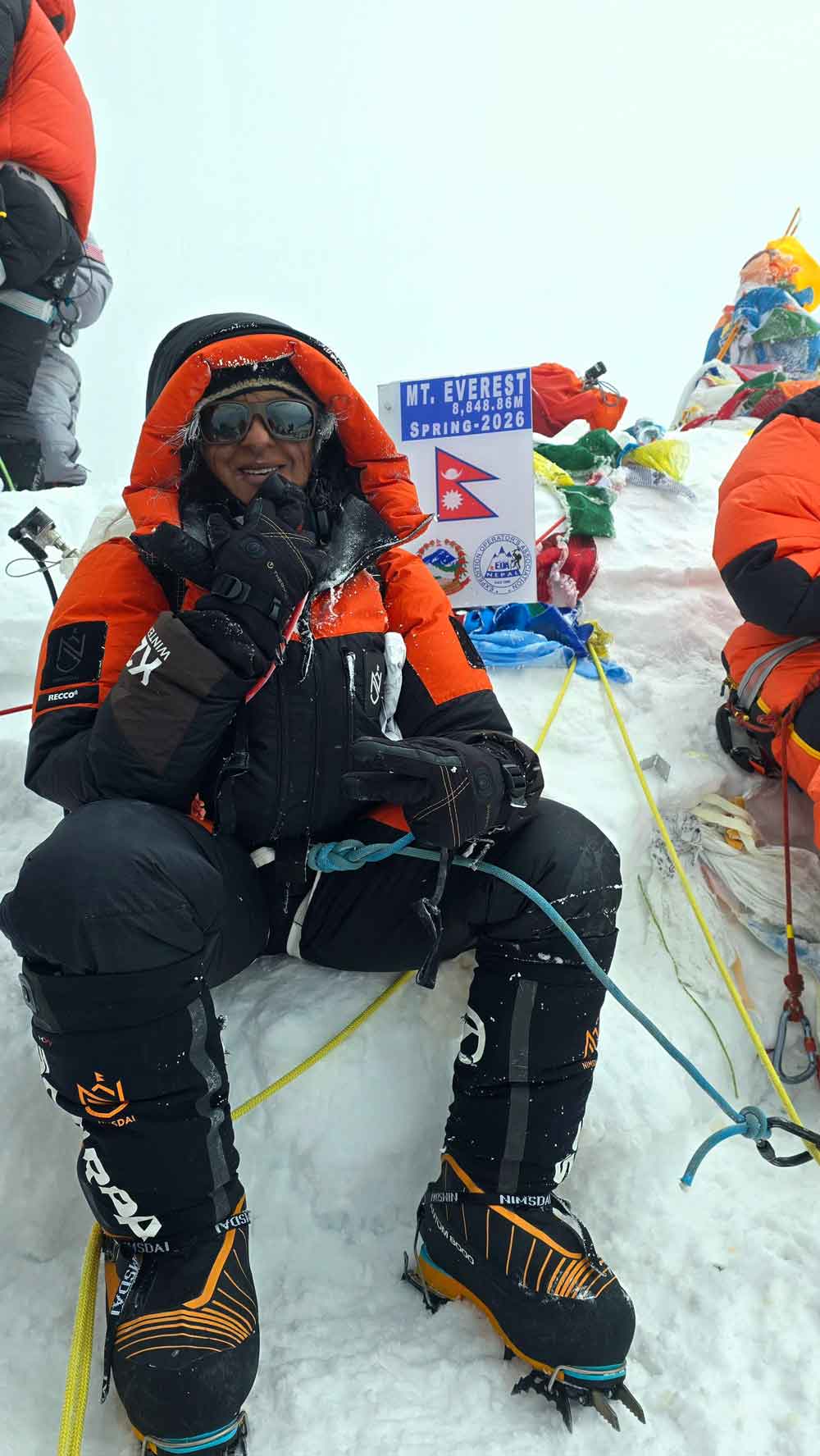
There were fewer than 50 people on the mountain that day since it was the very last day. Everyone else from the other groups had summited. ‘When my sherpa and I reached the peak was empty except for one foreign climber who was waiting for his team. I had the opportunity to take it all in without any crowds for a few minutes, and the first thing I did was to pray. Surprisingly, the other sherpas who summitted after me did the same, in gratitude to nature, to Sagarmatha, and to the entire universe that made this accomplishment possible.’
Being A Healthcare Professional
Throughout her climb, Dr Priya believes she was able to put herself in the shoes of the expedition leader, because of her profession. ‘I would compare the stress I experience as a healthcare professional dealing with emergencies to what my expedition leader was no doubt going through. Just as I’m responsible for lives, so is he. I trusted his decisions, just as patients trust my decisions as a doctor. I also had immense faith in my sherpa, a father-to-be who was my guide. If you don’t follow instructions and decide to do your own thing, you’re risking two lives, his and your own, which is not fair. So, it teaches you teamwork and caring in an environment where things are not in your control.’
Being a doctor, Dr Priya also understands her body better than most, and on every climb, and has tended to people who fell ill. By the end of each trek, she usually donates her medicines to those who need them, leaving the remaining supplies with the sherpas to stock their medicine bags. ‘Since we have to be mindful of how much we carry, I always combine my medicine kit with my sherpa’s, so we can make full use of everything available.’
The Environmental Impact
Because of the increasing number of climbers in recent years, there has been overcrowding and pollution on Everest, which Priya acknowledges, while adding that there are changes taking place and people are becoming more mindful. ‘All the way from base camp to Khumbu, Camps 1 to 3, and even Camp 4, which is the highest, there was litter. You have to heat ice to make water for instant food and cooking. So, you’re carrying these plastic food packets or containers, which are eventually discarded. There were also a lot of Coke cans lying around. It’s a popular drink because its sugar and caffeine content give you a boost. You’re already hypoxic and tired, but you still have to consciously put the trash back in your backpack and discard it later. So, the rules are much stricter now, and expedition leaders are also watching out. Sherpas are cleaning as much as they can, trying to keep the place ready for the next season.’
She adds, ‘Even toilet usage is changing. They have barrels for people to use until Camp 2. Higher up, when you’re at Camp 3 and 4, you can pee in the snow since it degrades, but there are now strict rules for poop, since it isn’t biodegradable. You have to carry it back in special barcoded bags, and hand it over to the Sagarmatha Pollution Control Committee, which has its tent between the base camp and Khumbu.’
Self-care Is Not Selfish
Dr Priya believes that whether they are professionals, homemakers, caregivers, or all three, women often place everyone else's needs ahead of their own. Unfortunately, she sees the consequences of this every day in her medical practice. ‘The biggest gift you can give your family is your own well-being.’ She has witnessed families devastated when parents develop preventable illnesses, with children and partners having to shoulder overwhelming responsibilities. Many of these situations, she believes, could have been mitigated through earlier attention to health.

She urges women to stop thinking of exercise as a luxury squeezed into spare time. Nor does she accept the common argument that household work counts as physical fitness. ‘Sweeping, mopping, and lifting groceries often happen with poor posture, placing unnecessary strain on the back and joints. Structured exercise, by contrast, builds strength, balance, and mobility while protecting the body from age-related decline.' Her prescription is to combine strength training, cardio, flexibility, and mobility exercises at least four times a week.
Preserving Hope
Back home, Dr Priya’s newest passion is ‘onco-fertility’, a rapidly growing specialty that focuses on preserving fertility for young cancer patients before treatment begins. ‘While survival rightly remains the first priority, many patients only begin thinking about fertility years later, when they are ready to start families. By then, the opportunity may have passed. With onco-fertility, eggs, sperm, or reproductive tissue can often be preserved before treatment, giving survivors the possibility of having biological children in the future.’
She adds, ‘This specialty was at a nascent stage a decade ago, but now we have a formal medical society, and are collaborating with one another, learning from global platforms and researchers. Locally too, we are working with oncologists, onco-surgeons and reproductive specialists to create data for the Indian scenario.’
Dr Priya has established the GG Hospital Fertility Research Foundation to support patients who cannot afford fertility preservation. ‘I formally launched it in May this year, while I was on Sagarmatha, and it is going to target the economically disadvantaged.’ She believes that financial constraints should not deny a young cancer survivor the chance to dream of parenthood.