Every morning at 5 am, Sunita Devi lights the chulha or stove in her village in Bihar, prepares tea, and sorts the vegetables she will sell later in the day. By noon, she is stitching blouses for neighbours on a borrowed sewing machine. In the evening, she manages the household accounts, stretching her husband’s irregular construction wages. Ask Sunita if she works, and she smiles politely. ‘Of course,’ she says. Ask official data if Sunita works, and the answer is far less certain.
For decades, millions of women across India have powered households and local economies without being fully seen in the numbers that guide policy. This may finally begin to change. In February 2026, the Government of India is set to launch the country’s first nationwide National Household Income Survey (NHIS), a landmark exercise that could transform how women’s work and income are understood.
Income Data And Women
For decades now, India has relied on consumption and expenditure surveys to assess economic well-being. While useful, these surveys often miss how money actually flows into households and who earns it. Women’s incomes, in particular, are frequently fragmented, seasonal, informal, or routed through family enterprises, making them harder to capture.
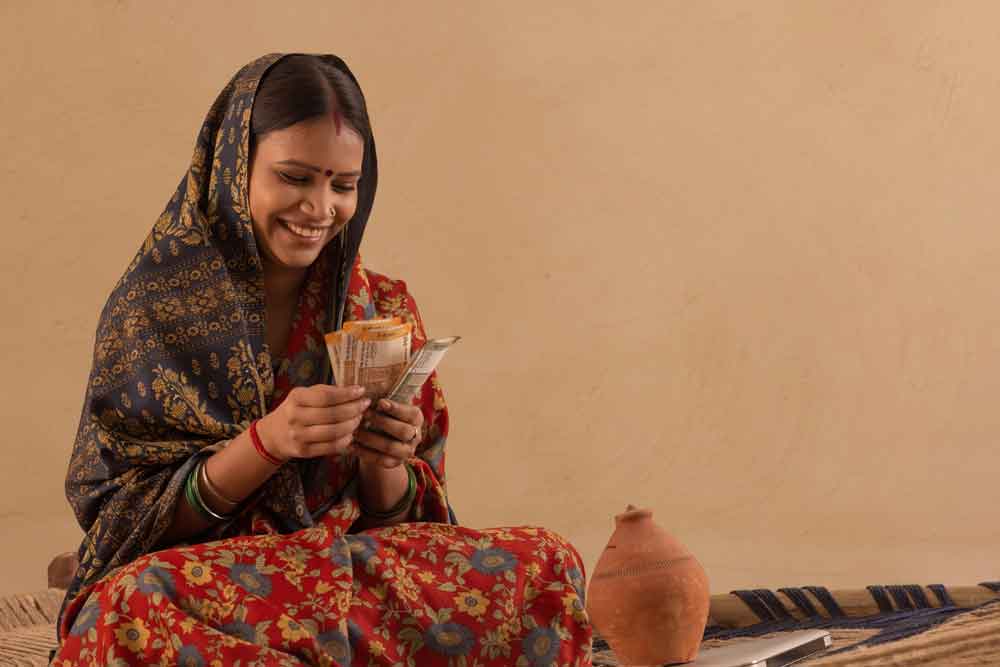
According to the Periodic Labour Force Survey (PLFS), women’s labour force participation remains significantly lower than men’s. Yet economists and gender researchers have repeatedly pointed out that participation data understates reality. Women’s unpaid labour, home-based work, subsistence farming, caregiving, and contribution to family businesses rarely translate into formal wages and therefore rarely show up in income statistics.
Take Meenakshi, a dairy farmer in Tamil Nadu. She wakes before sunrise to milk the family’s cows, manages fodder, negotiates with the local milk cooperative, and keeps track of payments. The income is deposited in her husband’s bank account because the land is in his name. Officially, she is not working, but in practice, the dairy survives because of her labour.
What The NHIS Can Change
The upcoming NHIS, to be conducted by the National Statistics Office under the Ministry of Statistics and Programme Implementation, aims to capture detailed information on household earnings, expenditure patterns, and sources of income across rural and urban India. Crucially, it will track income from wages, self-employment, property, and remittances. This matters deeply for women.
Women are overrepresented in self-employment, informal work, family enterprises, and home-based production. They are also key recipients and managers of remittances from migrant husbands, sons, or brothers. Yet, these income streams often fall through the cracks of conventional surveys.
By mapping who earns, how much, and from where, the NHIS could offer the clearest picture yet of women’s economic roles across caste, class, region, and age.
From Dependents To Earners
One of the most damaging consequences of poor income data is the persistent framing of women as dependents. This affects everything from welfare eligibility to credit access. The McKinsey Global Institute has estimated that unpaid care work that is performed overwhelmingly by women would amount to trillions of dollars if monetised. Yet, when policies are designed without acknowledging women as earners, benefits often bypass them.
For instance, old-age pensions for women are frequently set too low because women are assumed to have family support. Maternity benefits may miss informal workers because their incomes are undocumented. Skill development programs may fail because they don’t reflect the sectors where women already generate income. Better income data can change that calculus.
Data Shapes Dignity
In Jharkhand, members of a women’s self-help group that produces leaf plates once struggled to access bank credit. Their work was considered supplementary. But when a local NGO helped document their collective earnings, banks began to see them not as beneficiaries, but as entrepreneurs. If that kind of recognition is scaled up nationally, the impact could be profound.
With accurate income, data pensions can be calibrated to reflect women’s actual lifetime earnings and vulnerabilities. Maternity benefits can be extended more effectively to informal and self-employed women. Entrepreneurship schemes can be targeted at women-run micro-enterprises that already exist but lack formal recognition. Skill programs can build on women’s current income activities instead of pushing them into unsuitable roles.
Another often-overlooked aspect of women’s economic lives is remittance management. Across India, women are frequently the financial anchors who budget, save, repay loans, and invest in children’s education. By systematically capturing remittance flows, the NHIS could highlight women’s role as financial decision-makers, which is a critical step toward policies that support their financial literacy, savings, and asset ownership.
The Ripple Effect
Income inequality in India is not gender-neutral. Women are more likely to be at the lower end of income distributions, particularly single women, widows, elderly women, and women from marginalised communities. With robust income data, these inequalities can become visible and therefore harder to ignore.
It could reveal, for example, how much of a household’s income comes from women’s labour, or how women’s earnings vary by region and social group.
Survey Methodologies
Of course, a survey is only as powerful as its design and implementation. Gender experts stress the importance of asking the right questions about individual contributions, control over income, and decision-making power within households. Enumerators must be trained to speak to women directly, not only to male heads of households. If the NHIS succeeds on these fronts, it could mark a quiet revolution in India’s economic statistics. The National Household Income Survey has the potential to do what Indian statistics have rarely done before, by acknowledging women not just as caregivers or beneficiaries, but as workers, earners and asset holders.