On May 11 each year, India celebrates National Technology Day. The word technology is traditionally associated with laboratories, satellites, software parks, and scientific breakthroughs. For decades, it conjured up the familiar image of coders in Bengaluru, engineers in white coats, or startup founders pitching apps to investors. The story is very different now. A woman farmer in Maharashtra can check weather forecasts and soil data on her smartphone before sowing crops and a handloom artisan in Kutch can livestream her embroidery to customers in Canada. Even a mother in Chennai can use AI tools to manage household finances, tutor her children, and launch a side hustle from her kitchen table. Technology is no longer confined to STEM degrees or Silicon Valley-style innovation. It has permeated to homes, farms, WhatsApp groups, and small businesses led by women who do not necessarily call themselves ‘tech-savvy’, but are integrating technology into everyday life.
From Users To Earners
For years, the conversation around women and technology focused heavily on representation in engineering and IT. While that still remains important, women are no longer just consumers of technology. Women entrepreneurs are building businesses entirely through digital ecosystems. Instagram, UPI payments, Canva-designed menus, and AI-generated marketing captions can create a viable business model from a smartphone. Platforms such as Canva, ChatGPT, and Google Gemini have lowered the intimidation barrier around technology. Women who may never have learned coding are now using AI to write product descriptions, design catalogues, create social media campaigns, draft emails, plan budgets, and brainstorm business ideas. They can learn branding strategies from YouTube tutorials and automate customer communication using simple AI prompts.
Enabling Agriculturists
Women comprise a significant portion of India’s agricultural workforce, yet they have historically had limited access to farming technology, market intelligence, and financial systems. Smartphones are beginning to change that. Today, women farmers are using agri-tech platforms for weather predictions, crop pricing, irrigation management, and government scheme information. WhatsApp groups have become informal knowledge networks where women exchange advice on seeds, pests, fertilisers, and market rates. Digital payments have also increased financial independence. Direct benefit transfers into bank accounts linked to mobile phones mean many rural women now have greater control over money than previous generations did. In several states, women-led self-help groups are embracing e-commerce and digital marketplaces to sell pickles, millets, handicrafts, and organic produce beyond their villages.
India’s Craftswomen
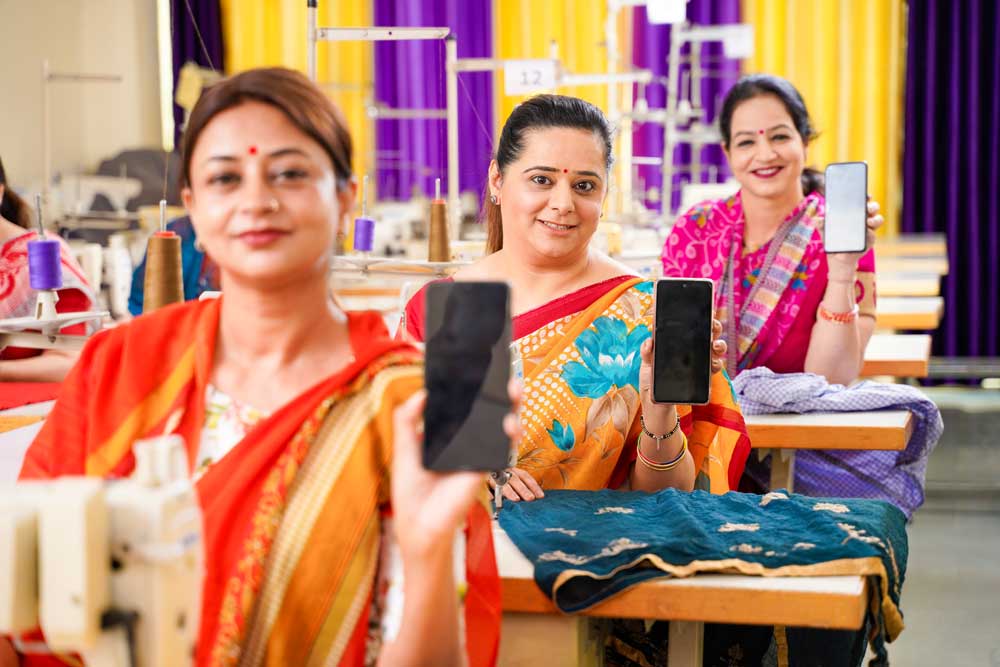
India’s artisan economy has traditionally relied on physical exhibitions, seasonal fairs, and word-of-mouth sales. Digital platforms have radically altered that landscape. A craftswoman no longer depends solely on middlemen visiting once a month. She can upload products online, accept digital payments, and connect directly with customers across the country. Women artisans now use Instagram Reels, Etsy stores, WhatsApp Business accounts, and online marketplaces to build personal brands around crafts that were once hyperlocal, without leaving their village. What has accelerated this shift is the growing ease of content creation. Earlier, professional photography, design, and marketing required money and technical training. Today, free mobile apps and AI-powered tools can generate logos, edit product images, remove backgrounds, suggest captions, and even recommend posting schedules. Women who may never enter formal corporate workplaces are participating in the digital economy on their own terms, from homes, small towns, and rural communities.
AI Enters The Indian Household
AI tools are increasingly becoming invisible domestic assistants. Women are using them for meal planning, travel itineraries, exam preparation schedules, financial spreadsheets, parenting ideas, resume writing, and language translation. For working mothers especially, technology is evolving into a time-management ally. A parent can use AI to simplify a Class 8 science chapter for a child while as caregiver can create medication reminders and health trackers. Women returning to work after career breaks are using online courses and AI support tools to rebuild confidence and update skills. These interactions are also reducing the fear traditionally associated with technology. Earlier generations often viewed tech as complicated, male-dominated, and inaccessible. With today’s tools, you no longer need to ‘know computers’ to benefit from technology.
The Creator Economy
Indian women are also reshaping technology through content and community-building. From finance educators and sustainable living advocates to regional-language storytellers and parenting influencers, women creators are building audiences and incomes using digital platforms. Many are leveraging AI tools for scripting, editing, subtitles, research, and content planning. Regional creators, in particular, are using translation and voice tools to expand beyond linguistic barriers. This creator economy has opened new pathways for women who may have paused traditional careers due to caregiving responsibilities, mobility constraints, or social expectations.
National Technology Day should not only celebrate patents and startups. It should also celebrate the women who are using accessible technology to create income, independence and efficiency in ways previous generations could not.